
I am a Ph.D student at Shanghai Jiao Tong University (SJTU), under the supervision of Prof. Xiangyang Zhu (朱向阳). I hold a Bachelor of Engineering (B.Eng.) degree in Engineering Mechanics, with a minor in Computer Science and Technology, also from SJTU. I graduated with honors as the top student in my major through the prestigious Zhiyuan Honor Program. My research centers on in-hand manipulation with dexterous hands, a complex system that integrates various robotics domains. This work draws on my interest and experience in traditional control, mechanics modeling, reinforcement learning, imitation learning, tactile perception, tactile feedback in teleoperation, generative algorithms, motion planning, and force control.
I was awarded the Outstanding Winner and the INFORMS Award in the 2021 Mathematical Contest in Modeling (MCM) and received the First Prize in the National Zhou Peiyuan Mechanics Competition the same year.
I enjoy guitar🎸 and VAE (Song Xu)’s music🎶. If someone invites me to play volleyball 🏐 or go snowboarding 🏂, I’ll definitely join!
📬 Contact
- Email: jindadu00@sjtu.edu.cn
- GitHub: jindadu00
- WeChat: JaydenDu_666
- Phone: (+86) 15157790668
🎓 Education
-
Ph.D. student in Robotics(Honor)
Institute of Robotics, Shanghai Jiao Tong University, 2022–present
- GPA: 3.9 / 4.0
-
B.E. in Engineering Mechanics(Honor)
School of Ocean and Civil Engineering, Shanghai Jiao Tong University, 2018–2022
- GPA: 4.0 / 4.3 (90.4/100)
- Ranking: 1 / 26 in the Engineering Mechanics department
- Minor: B.E. in Computer Science
🎖 Honors and Awards
- 2022.09 Zhiyuan Honor Program(Ph.D) (Top 5%)
- 2022.07 Outstanding Graduate of Shanghai(Top 5%)
- 2022.07 Zhiyuan Outstanding Student Scholarship (Top 0.1%)
- 2022.06 Outstanding Undergraduate Thesis in Mechanics at National Universities. (Top 1%)
- 2021.10 National Scholarship (Top 1%)
- 2021.05 National Zhou Peiyuan Mechanics Competition, First Prize(Top 1%)
- 2021.03 Mathematical Contest in Modeling, Outstanding Winner and the INFORMS Award(Top 0.1%)
- 2020.10 National Scholarship (Top 1%)
- 2019.02 Zhiyuan Honor Program(Undergraduate) (Top 5%)
📝 Publications
💻 Projects
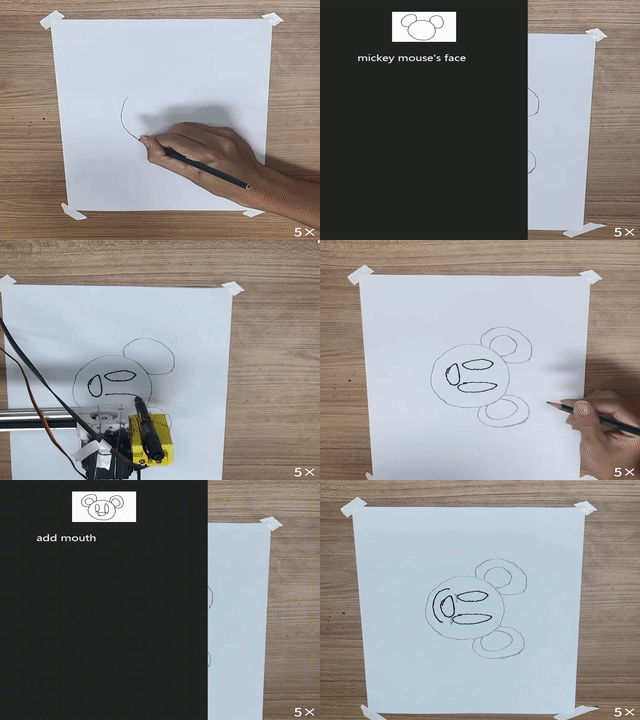
Interactive Drawing Robot(2024)
Jinda Du, Shaoli Hu, Hang Chen
The algorithm we adopted is capable of recognizing and complementing the user’s creative intent, enabling the robot to make meaningful artistic contributions. This requires the robot not only to understand the existing elements on the canvas but also to dynamically adjust its creative process based on partial strokes or descriptive prompts provided by the user. By responding to text descriptions or drawing inputs, the robot can refine its actions in real time, ensuring that the output aligns with the user’s expectations.
Hardware Design: Developed a low-cost XYZ-structure CNC plotter to replace expensive robotic arms, using stepper and servo motors for precision control in X, Y, and Z axes. Implemented Arduino microcontroller to manage motion via G-code.
Software Development: Designed Python scripts for image-to-G-code conversion and implemented real-time control using Processing IDE. Enhanced image processing pipeline with threshold segmentation, morphological operations, and mask application for dynamic drawing generation.
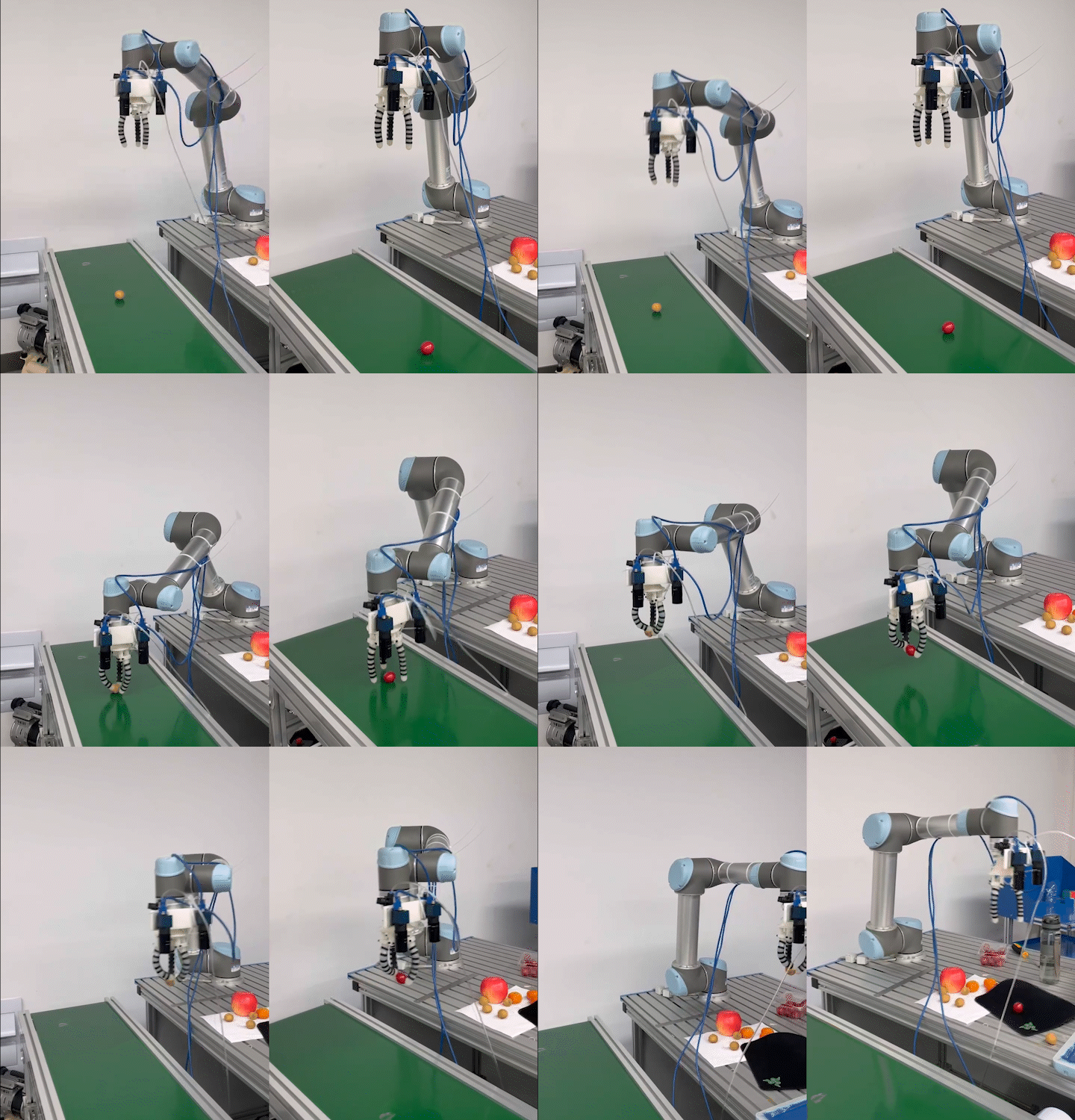
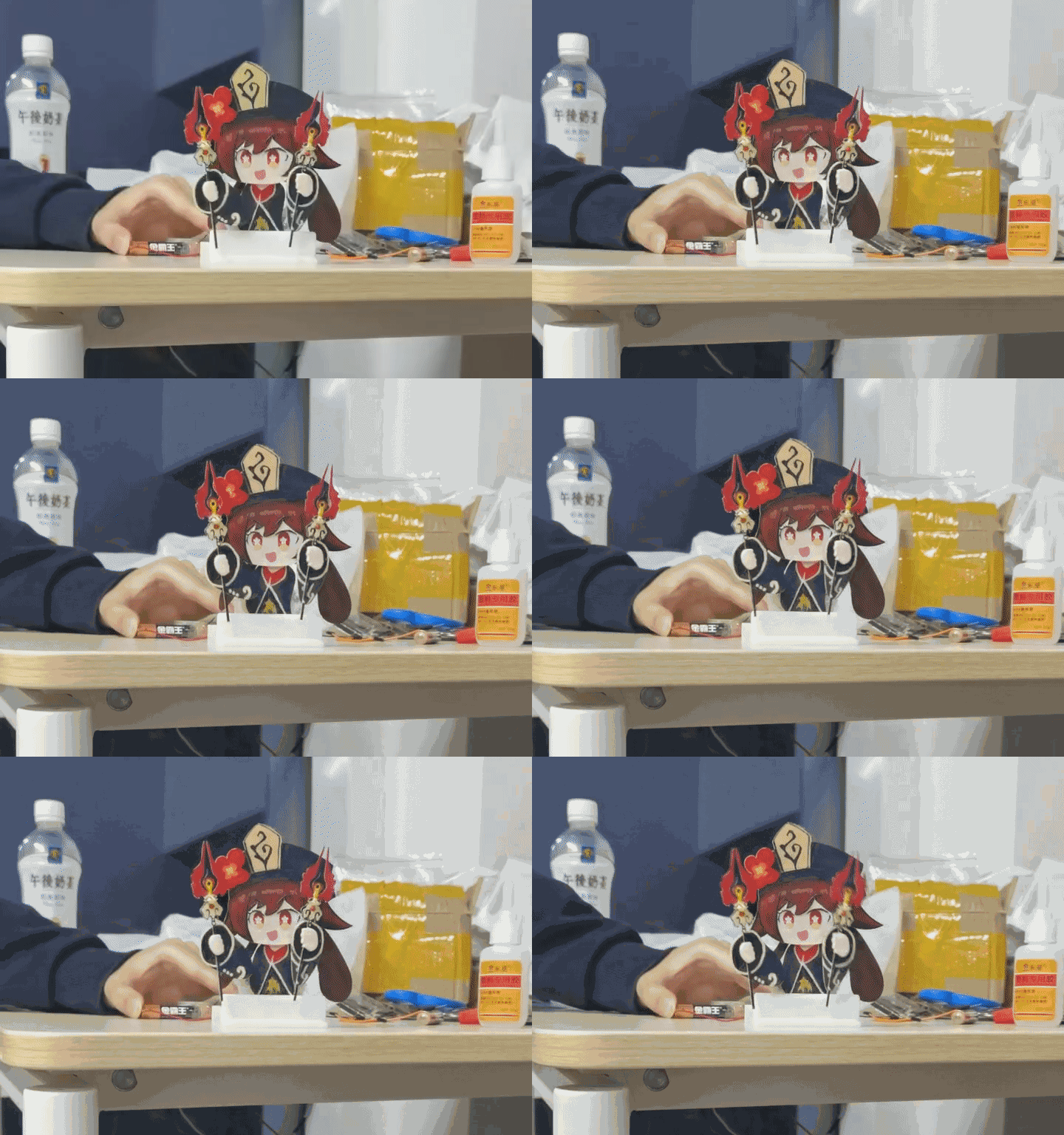
Automated Pick-and-Place of Fruits Using a UR Robot Arm with Soft Grippers(2021)
Jinda Du, Weicheng Huang, Yi Shen, Yiming Wang
Control UR Robotic Arm to Visually Capture Specific Fruits With HSV Target-Detection
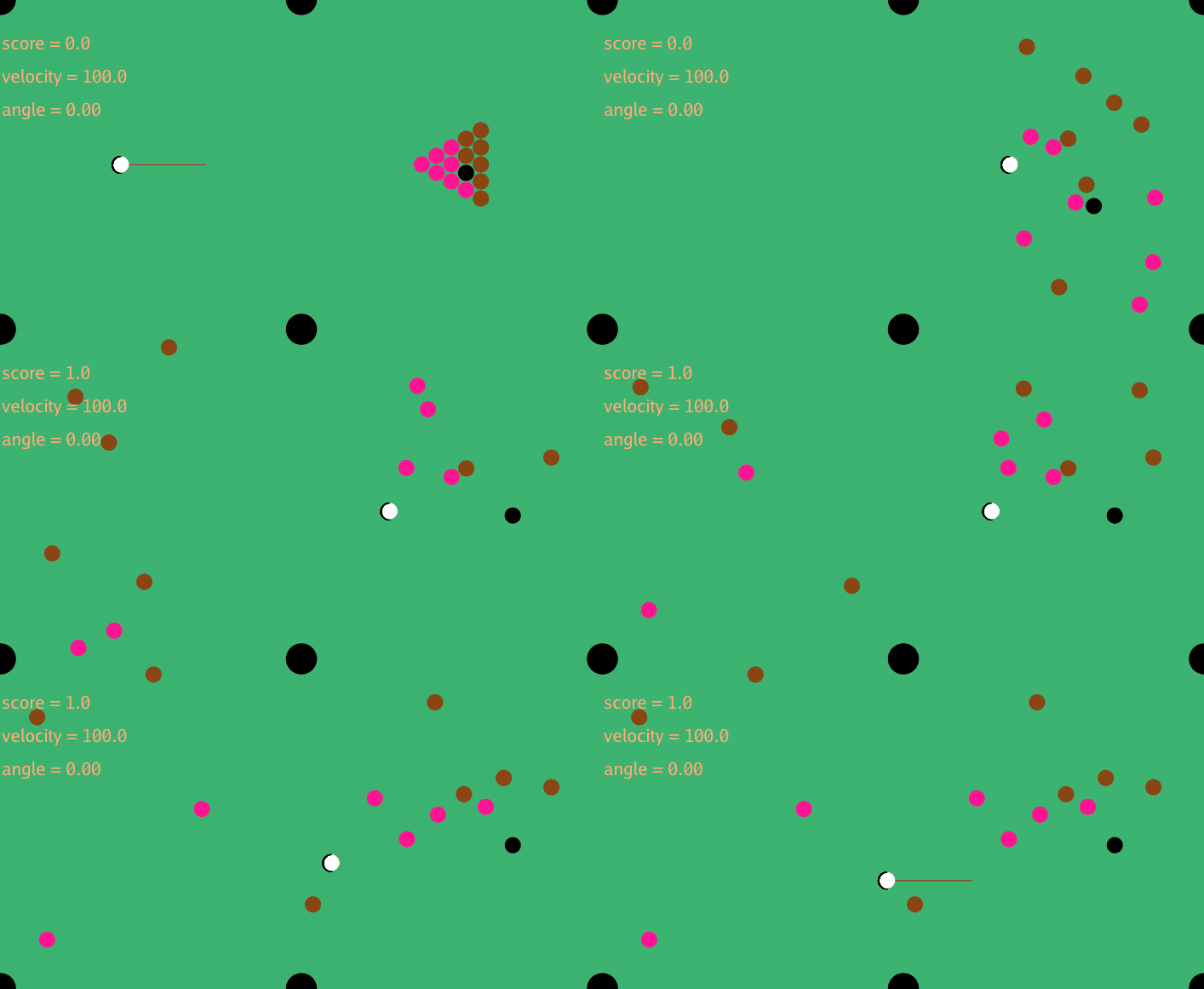
Billiards Mini Game Accelerated Using the Taichi Framework(2022)
Kun Song, Jinda Du, Yueshi Dong, Yiming Wang
We developed our own physics engine to simulate 3D ball motion and collisions, which was used to create a multiplayer competitive billiards mini-game. In the game, players can strike the cue ball, imparting it with initial momentum and angular momentum, and the subsequent gameplay is simulated accordingly. Additionally, we accelerated this simulation process using the Taichi framework, enabling smooth performance on standard laptops.
-
Reinforcement Learning Dominates in Multiplayer Snake Competition(2022)
Jinda Du, Junhan Xu, Junchao Gong, Yuanwei Zhang
This was an online multiplayer Snake Challenge organized by Ubiquant Investment (Beijing) Corp, Ltd. Our team fully implemented the game platform according to the competition rules and continuously upgraded our snake through adversarial training. Ultimately, we secured second place in the competition.
Action Sequence Design: Instead of returning a single action per turn, the game requires a sequence of actions to be returned.
Perception and Game Screen Analysis: Developed a multi-layer perceptron to hierarchically extract game information based on different game items (e.g., food).
Reward System: Designed rewards based on factors like snake length, kills, item collection, survival, and early-game advantage (prioritizing items in the first ten turns).
Opponent Sampling and Modeling: Each round sampled opponents with 10% V0, 10% V1, and 80% VN (latest strategies or human-controlled opponents), with periodic updates to the opponent model.
Training Strategy:
- Initial Version (V0): Implemented a depth-first search algorithm with a greedy strategy to create the non-reinforcement-learning-based snake, which provided a foundational baseline.
- Reinforcement Learning Version (V1): Applied Proximal Policy Optimization (PPO) to train the reinforcement learning model, initially using V0 as the opponent until V1 consistently outperformed it, ensuring incremental learning improvement.
- Final Strategy: Optimized the model by introducing aggressive tactics, such as wall-passing kills, during the final phase to maximize competitive performance.
-
Accurate Decoding of Surface Electromyographic Signals in Dynamic Contraction Processes by Integrating Motion Information.(2023)
Jinda Du, Chen Chen, Xiangyang Zhu
A multimodal architecture model was built, where the joint angle data of the subjects was embedded to extract feature vectors, and electromyography (EMG) signals were processed using a convolutional neural network (CNN) to extract feature maps. These were then fused through cross-modal integration using mutual attention, exploring the correlation and complementary information between the subject’s motion state and EMG signals, aiming to predict the decoding of surface electromyographic signals during dynamic contraction processes. In the simulation dataset, the gradient convolutional kernel compensation(gCKC) algorithm and FastICA achieved about 90% discharge decoding accuracy for static contractions, but this accuracy dropped to around 50% for dynamic processes. Our proposed algorithm, however, maintained approximately 90% discharge accuracy for motor unit discharge sequences in both static and dynamic contractions.
-
Wrinkle Identification and Detection of Coated Fabric Membranes(2019)
Jinda Du, Songyan Zhang, Jiapeng He, Daxu Zhang
Data was collected through fabric wrinkling experiments. Image augmentation techniques such as cropping and rotation were applied to the collected data, while Gamma correction and histogram equalization were used for image preprocessing. Thousands of images were labeled with supervision points, and a custom dataset was built. To address the elongated shape of wrinkles, spatial pyramid pooling was introduced. For handling the blurred edges of wrinkles, low-dimensional and high-dimensional features were concatenated during decoding. The trained model performed well on the validation set, achieving an accuracy of 90%, and a frontend web platform was developed for this system.
-
Rope Driven Redundant Snake Robot Simulation(2022)
Jinda Du, Zhuyong Liu
-
Computer-Aided-Kinematics-and-Dynamics-of-Mechanical-Systems(2020)
Jinda Du, Jinyang Liu
-
Finite-Element-Analysis-of-Bar-System(2020)
Jinda Du, Fangmin Tao
🛠️ Skills
- MATLAB: Muscle electromyography (EMG) data processing, dynamics simulation of mechanical structures
- Python: Machine learning, PyTorch/TensorFlow-based deep learning, machine vision
- C++: High-performance mechanical simulation, 2D/3D finite element implementation for beam structures
- Mechanical Analysis Software: ABAQUS, Ansys, Fluent, Adams
- Auxiliary Research Skills: ROS2, Isaac Gym, LaTeX, Ubuntu, Git, Solidworks, EMGLab, QT, PyGame
📚 Seleted Courses
Graduate Courses:
- Modern Control Theory – 94 (4,0)
- Advanced Robotics Control – 92 (4,0)
- Probability Theory and Mathematical Statistics – 96 (4,0)
Undergraduate Courses:
- Physics(Honor) – 100 (4.3)
- Advanced Dynamics – 100 (4.3)
- Numerical Methods and Programming – 98 (4.3)
- Fluid Mechanics – 98 (4.3)
- Computational Solid Mechanics – 98 (4.3)
- Theoretical Mechanics(Honor) – 97 (4.3)
- Elasticity Theory – 97 (4.3)
- C++ Programming and Design – 95 (4.3)
- Automatic Control Theory – 95 (4.3)
- Humanoid Robotics and Artificial Intelligence – 94 (4.0)
- Machine Learning – 94 (4.0)
- Data Structures(Honor) (Yuyong Class) – 92 (4.0)
👨🏫 Teaching
- Teaching Assistant: (STAT6001H) Probability Theory and Mathematical Statistics(Honor), 2022 Spring
- Teaching Assistant: (CS0501-02) Data Structures, 2023 Fall
- Teaching Assistant: (CS0501H-02) Data Structures(Honor), 2023 Spring
- Teaching Assistant: (CS1652-01) Data Structures(AI), 2024 Spring
🌍 Languages
- Languages: English and Chinese
- IELTS: 7.0 = Reading 9.0 + Listening 7.5 + Speaking 5.5 + Writing 6.0